It's the first question everyone asks, and the hardest to answer honestly. The cost of building a home in Jordan depends on so many variables (your land, the size of the home, the structural system, the quality of finishes, and the site conditions) that any single number is misleading.
What we can do is break down the real factors that drive cost, explain what to expect at different levels, and help you understand where money goes and where surprises come from.
The short answer
For a newly built home in Jordan, construction costs generally fall within a wide range depending on the scope and quality of the project. A basic build with standard finishes will cost significantly less per square metre than a fully designed, high-specification home with premium systems.
The variables that push cost up or down are well understood, but they interact differently on every project. That's why serious cost estimates need to be project-specific, not averaged.
Factor 1: The land itself
The cost of the land is separate from the cost of construction, but the land's characteristics directly affect construction cost. Two plots at the same land price can have very different build costs.
What matters:
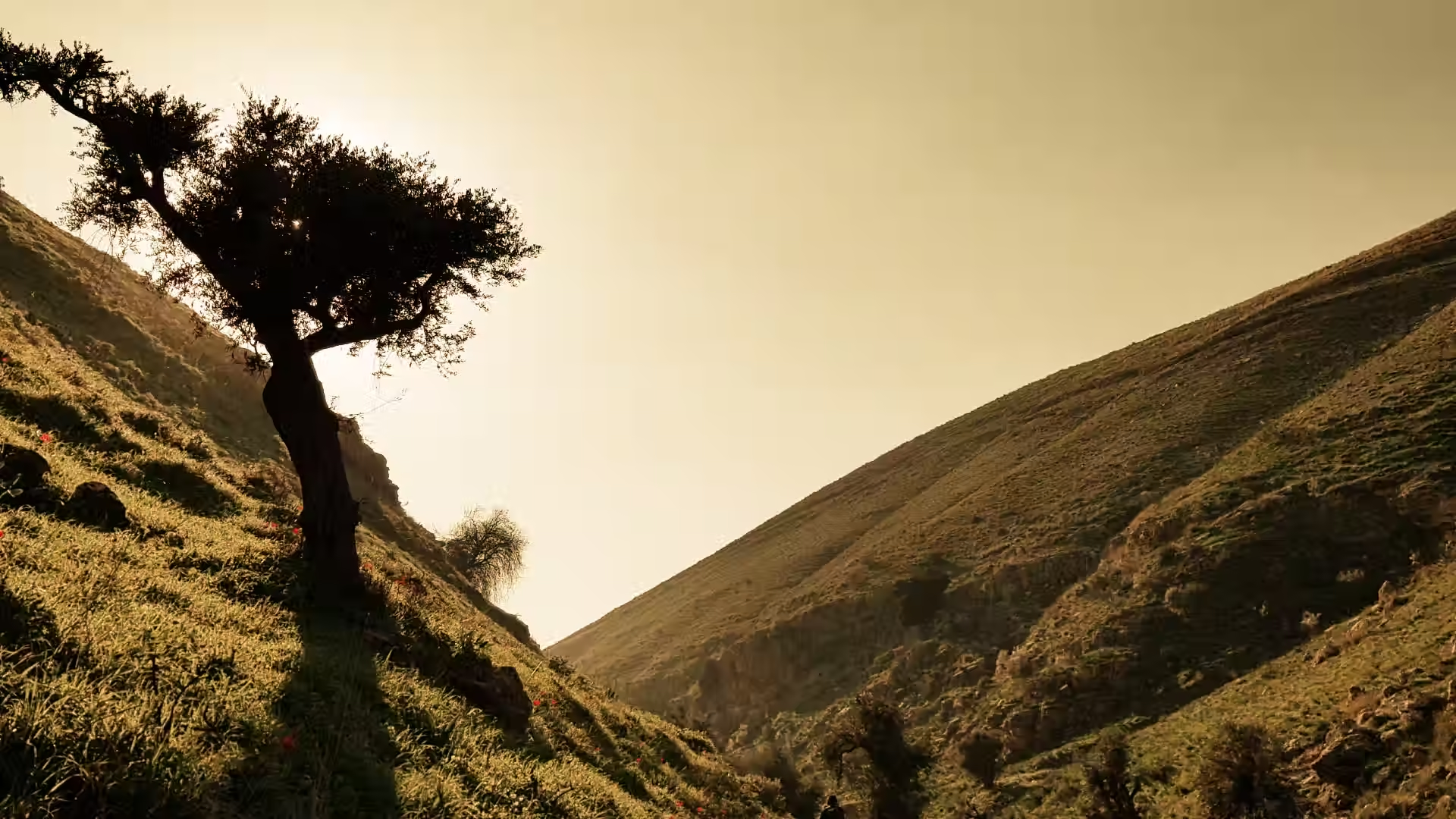
Topography. A flat plot requires a simple foundation. A sloped plot may need retaining walls, cut and fill, and more complex structural engineering. On steep sites, foundation and site preparation alone can add 15–30% to the total build cost.
Soil conditions. Some areas in Jordan have rocky soil that requires excavation equipment. Others have soft or fill soil that needs deeper foundations. A geotechnical survey (فحص تربة) reveals what's below the surface, and it's worth doing before you buy.
Infrastructure. If your plot has municipal water, sewage, and electrical connections on the street, you're starting from a good position. If not, connecting to utilities (or installing alternatives like septic systems and water storage) adds cost and time.
Access. A plot on a narrow unpaved road may require temporary access routes for heavy equipment during construction. If the crane can't reach the site, your construction method (and cost) may need to change.
Factor 2: Size and layout
The total area of the home is the most obvious cost driver, but it's not the only dimension. A 300 sqm home on one floor costs differently than a 300 sqm home on two floors, and both cost differently than a 300 sqm home with a basement.
Single floor vs. two floors. A single-floor home has a larger foundation footprint and a larger roof, both expensive elements. A two-floor home reduces the footprint but adds structural complexity and a staircase. The cost per square metre is often lower for two-floor designs, but the total cost depends on the layout.
Compactness. A simple, compact plan costs less than one with multiple wings, courtyards, and projections. Every external corner and every jog in the plan adds formwork, materials, and labour. The most cost-efficient homes are those with clean, regular geometries.
Wet areas. Kitchens and bathrooms are the most expensive rooms per square metre, plumbing, waterproofing, tiling, fixtures. A home with three bathrooms costs more than one with two, even at the same total area.
Factor 3: Structural system
The structural system is the skeleton of your home, and it's one of the most significant cost components. In Jordan, the most common systems are:
Conventional reinforced concrete (cast-in-place). The traditional method. Concrete is poured on-site into formwork. It's labour-intensive, weather-dependent, and requires careful on-site quality control. Most homes in Jordan are built this way.
Steel frame. Lighter and faster to erect than concrete, but requires specialist fabrication, fire protection, and different finishing details. Less common for residential in Jordan.
Precast reinforced concrete. Components are manufactured off-site in controlled factory conditions and assembled on-site. This approach offers higher precision, faster assembly, and less on-site waste, but requires a manufacturing and logistics system to support it.
Traditional block construction. Concrete block walls with a concrete frame. Common for lower-cost builds but offers less thermal performance and limited design flexibility.
The structural system you choose affects not just the cost of the structure itself, but also the construction timeline, the quality of finishes you can achieve, and the long-term energy performance of the home.
Factor 4: Finishes and systems
Finishes are where cost variation is widest. The difference between a basic finish and a premium finish can double the interior cost of a home.
Flooring. Local porcelain tiles at one end, imported natural stone or hardwood at the other. The range is enormous.
Kitchens. A standard kitchen with laminate cabinetry and local countertops costs a fraction of a custom-designed kitchen with solid surface or natural stone.
Bathrooms. Standard local sanitary ware vs. European branded fixtures. Standard tiles vs. large-format porcelain or natural stone. The fixtures alone can vary by a factor of five.
Heating. Central radiator heating with a gas boiler is the standard approach. Underfloor heating is more comfortable and more efficient, but costs more to install.
Cooling. Wall-mount split AC units are the most common and least expensive. Ducted central air conditioning is more discreet and provides better distribution, but costs significantly more.
Doors and windows. Standard aluminum windows vs. thermal break aluminum with double glazing. Standard interior doors vs. solid wood or custom joinery. Every opening is a decision point.
The key is to set your finish level early in the design process, not after the structure is built. Changing your mind about finishes mid-construction is one of the most common and expensive mistakes in any build project.
Factor 5: External works and landscaping
The house itself is not the only cost. The plot needs:
Boundary walls and gates, stone, block, or metal. The perimeter of your plot directly affects this cost.
Parking, covered or uncovered, paved or unpaved.
Landscaping, from basic levelling and planting to fully designed outdoor spaces with irrigation.
Swimming pool, if desired, this is a significant addition in both construction and ongoing maintenance cost.
Retaining walls, on sloped sites, these can be among the largest single cost items.
External works are frequently underestimated. On a typical project, they can represent 10–20% of the total build cost.
The hidden costs
Beyond construction, there are costs that many first-time builders don't anticipate:
Design fees. Architectural and engineering design is a professional service with real costs. Skipping or cheapening the design phase almost always leads to higher construction costs, because problems that should have been solved on paper get solved on site, with concrete and money.
Permit fees. Municipal building permit fees in Jordan are based on the area and type of construction. These are relatively modest compared to construction costs, but they're not zero.
Supervision. If you're not using an integrated design-and-build service, you'll need to hire a site supervisor or project manager. Without one, quality suffers and costs creep.
Contingency. Every responsible budget includes a contingency (typically 5–10% of the total construction cost) for unforeseen conditions, design changes, and price fluctuations. If your contractor doesn't mention contingency, your budget is probably missing it.
Why ranges don't help
You'll find articles online quoting construction cost "per square metre" for Jordan. These numbers are almost always misleading, because they average across wildly different project types, locations, and quality levels. A cost-per-square-metre figure that includes a basic village house and a luxury Abdoun villa tells you nothing about your project.
The only reliable way to understand what your home will cost is to start with your specific land, your specific requirements, and a professional assessment of what's feasible.
Get a real number for your project
Konn's DesignFit is designed to answer this exact question for your specific situation. For a small upfront investment, Konn's architects assess your land, design floor layouts to your requirements, and give you a realistic cost range and construction timeline, based on your land, your home, and your chosen finish level.
It's the difference between guessing from online averages and knowing what your project will actually cost.