
Construction
Reinforced Concrete vs. Steel Frame vs. Traditional Construction: Which Is Right for Your Home?
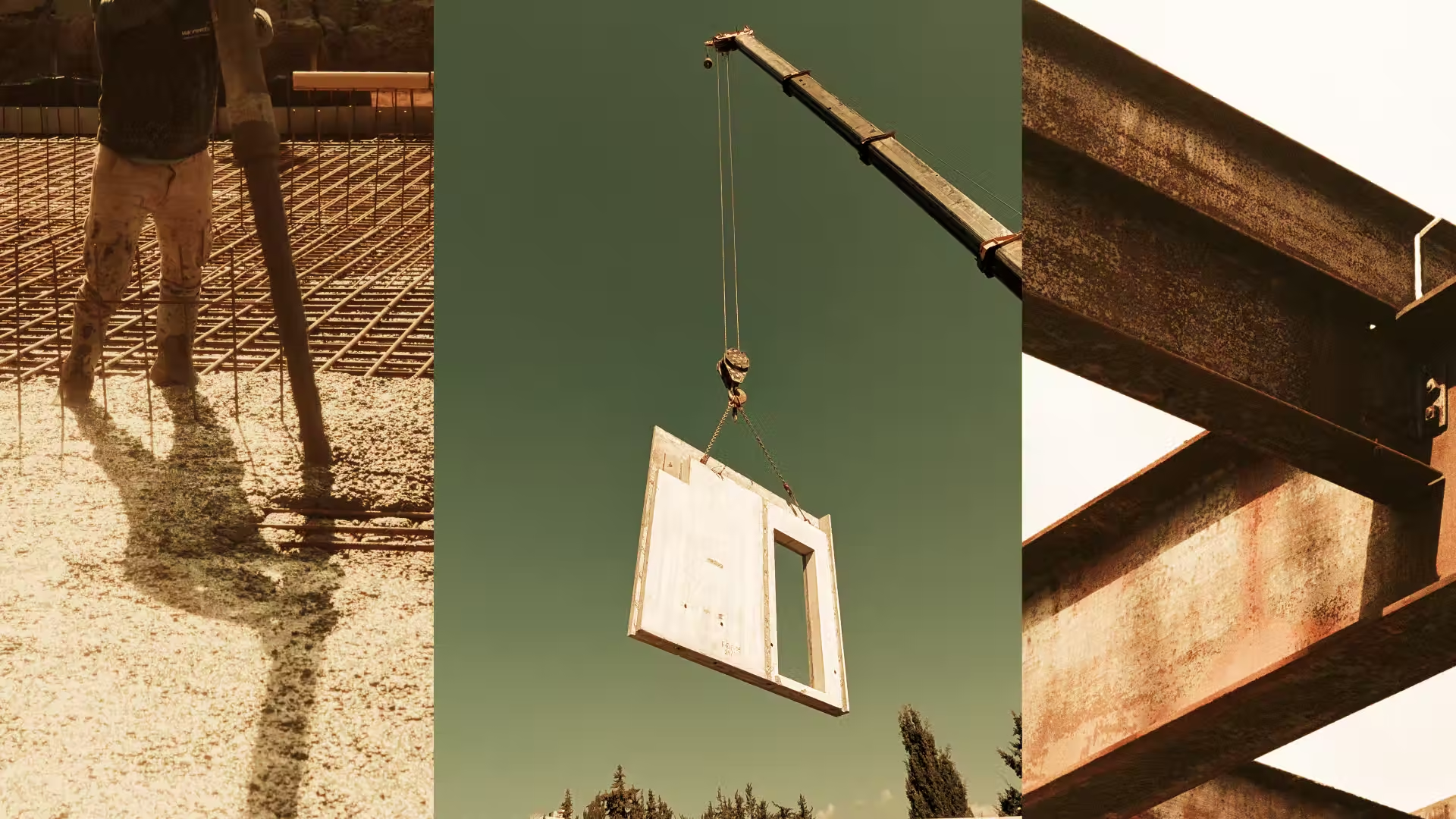
When you're building a home in Jordan, the structural system is one of the first and most consequential decisions you'll make. It determines how long your home lasts, how well it holds heat in winter and keeps cool in summer, how fast it goes up, and what it costs.
Three systems dominate residential construction in Jordan. Each has clear strengths and trade-offs.
Traditional construction in Jordan
Residential construction in Jordan has evolved through several eras. Older homes (particularly in Amman's established neighbourhoods) were built with thick natural stone walls that provided excellent thermal mass and durability. Those homes are still standing, and the quality of that stone was exceptional: dense, low absorption, consistent colour, and structurally rigid.
Modern construction moved to reinforced concrete frames with masonry infill walls. The most common wall section today is brick on the interior face, a layer of insulation in the middle, then a concrete backing behind natural stone cladding on the exterior. This is the standard, and it's what the Jordanian building code requires for thermal performance.
Stone cladding remains ubiquitous across Jordan, especially in Amman, where it's deeply tied to the city's architectural identity. But the quality of stone available today is noticeably lower than what was used in older construction, higher absorption rates, less consistent colour, and lower structural rigidity. It's still used everywhere, but it's increasingly a cosmetic material rather than a structural one. The stone is typically applied using traditional mortar methods rather than mechanical fixing, which adds labour time and introduces variability in long-term adhesion.
Strengths:
Widely understood. Every contractor in Jordan knows this method. Labour is accessible. Materials are local. For conventional designs on straightforward sites, it's the default path.
Trade-offs:
Even with the standard double-brick-and-insulation wall section, thermal performance depends heavily on execution. Insulation that's compressed, gapped, or improperly installed (common when there's no factory quality control) underperforms significantly. Thermal bridges at the concrete frame connections remain a persistent issue. Many homeowners in Jordan are familiar with cold walls in winter where the frame meets the masonry, that's a thermal bridge.
Quality varies project to project, crew to crew, day to day. Walls are built by hand on-site. Alignment, mortar consistency, and the continuity of the insulation layer all depend on supervision and workmanship. There's no controlled manufacturing environment.
Construction is slow. Everything happens on-site, sequentially, and is weather-dependent. A rain day is a lost day. A hot summer stretch affects concrete curing and mortar workability.
Damp and moisture problems are common, particularly in ground-floor walls and in areas with poor waterproofing detailing. Mould on interior walls, peeling paint, and deteriorating plaster are familiar issues in many Jordanian homes, not because the materials are bad, but because the on-site assembly isn't sealed to a consistent standard.
Steel frame
Steel-framed homes use factory-fabricated steel sections (columns, beams, and sometimes light-gauge steel studs for walls) assembled on-site. The frame goes up quickly, and the walls are infilled with insulated panels or block.
Strengths:
Speed of erection. A steel frame can be assembled in days, not weeks. The components are fabricated off-site to precise dimensions, so on-site work is largely assembly rather than construction.
Large spans. Steel is strong in tension, which means it can span wider distances without intermediate columns. If your design calls for open-plan living, large sliding doors, or cantilevered balconies, steel handles these more easily than concrete.
Lighter weight. Steel frames place less load on the foundation, which can reduce foundation costs on certain soil types.
Trade-offs:
Steel frame is less common for full residential construction in Jordan, though it can play a role in hybrid approaches, for example, in transitional spaces, smaller structures, or as part of a mixed structural system where it's paired with reinforced concrete. Finding contractors with residential steel-frame experience as the primary system is harder, and the specialist fabrication and erection skills cost more per hour than conventional concrete labour.
Fire protection. Steel loses structural integrity at high temperatures. In a residential context, steel members need to be protected, either through fire-rated cladding or intumescent coatings. This adds cost and complexity.
Thermal bridging. Steel conducts heat far more readily than concrete. Without careful detailing, steel members create thermal bridges (paths where heat escapes in winter and enters in summer) reducing the energy performance of the building envelope.
Sound insulation. Steel-framed walls and floors transmit sound more easily than concrete. Achieving good acoustic separation between rooms requires additional insulation and decoupling layers.
Corrosion. In Jordan's climate (particularly in areas with higher humidity or near the Dead Sea) steel requires ongoing protection against corrosion. Concrete doesn't have this problem.
Reinforced concrete, precast, off-site manufactured
Precast reinforced concrete takes the material that most Jordanian homes are already built with (concrete) and manufactures it in a factory instead of on-site. Structural components (walls, floors, beams) are cast in controlled conditions with precise tolerances, then transported to site and assembled.
Strengths:
Durability. Reinforced concrete is the most durable residential construction material available. A well-built reinforced concrete home is designed to stand for 100 years or more. It doesn't corrode, doesn't burn, and doesn't degrade with exposure.
Thermal mass. Concrete stores heat and releases it slowly. In Jordan's climate (hot days, cold nights) this thermal mass naturally moderates interior temperatures, reducing the load on heating and cooling systems.
Sealed envelope. When precast components are manufactured to tight tolerances and assembled with sealed joints, the result is a building envelope that's fully sealed against moisture, damp, and air infiltration. This eliminates the damp problems that plague many block-built homes in Jordan, mould on interior walls, peeling paint, and deteriorating plaster.
Factory precision. Components manufactured in a factory are not subject to on-site variables, weather, crew skill, supervision quality. Every panel is cast in a controlled environment with consistent concrete mix, reinforcement placement, and curing conditions. The result is higher and more consistent quality than anything achievable on-site.
Speed. Because components are manufactured off-site while the foundation is prepared on-site, the two processes run in parallel. Assembly of the structure on-site takes 2 to 4 weeks, compared to months for conventional construction. And because manufacturing happens during the permit period, the total project timeline compresses significantly.
Less waste. Factory manufacturing optimises material use. There's less formwork waste, less concrete waste, and less site disruption. The construction site is cleaner, quieter, and faster to complete.
Trade-offs:
Precast requires a manufacturing and logistics system. Not every contractor can offer it, you need access to a factory with the right moulds, quality control, and transport capabilities. It's not a method you can improvise with any local builder.
Transportation. Precast components are heavy and require cranes for assembly. The site needs to be accessible to heavy vehicles. Narrow streets or remote hillside plots may present logistics challenges.
Design coordination. Because components are manufactured before they arrive on-site, the design needs to be fully resolved before manufacturing begins. Changes during construction are more difficult and more expensive than with conventional methods, which is why getting the design right first matters even more.
How to think about this decision
The right system depends on your priorities:
If budget is the primary constraint and you have a straightforward design, traditional construction offers the lowest upfront cost, but expect variable thermal performance and more maintenance over time.
If large open spans and speed of erection matter most, steel has clear structural advantages, but be prepared for higher specialist costs and ongoing maintenance requirements.
If long-term durability, thermal performance, and build quality are priorities, reinforced concrete (particularly precast) offers the strongest combination of performance, speed, and lifespan. The upfront investment is higher than basic block, but the total cost of ownership over the life of the home is lower.
What Konn builds with
Konn's structural system is built for modularity. The core is precast reinforced concrete, manufactured off-site in controlled factory conditions and assembled on-site. But the system is designed to integrate steel and cast-in-place concrete where the design calls for it. For large spans, transitional spaces, and complex geometries, the structural approach adapts to what each home needs, not the other way around.
What stays consistent across every approach is the result: precision, a sealed building envelope, and a structure built to last generations.
If you're considering building and want to understand what's possible on your land (including cost, timeline, and how the structural system works for your specific project) a DesignFit is the place to start.